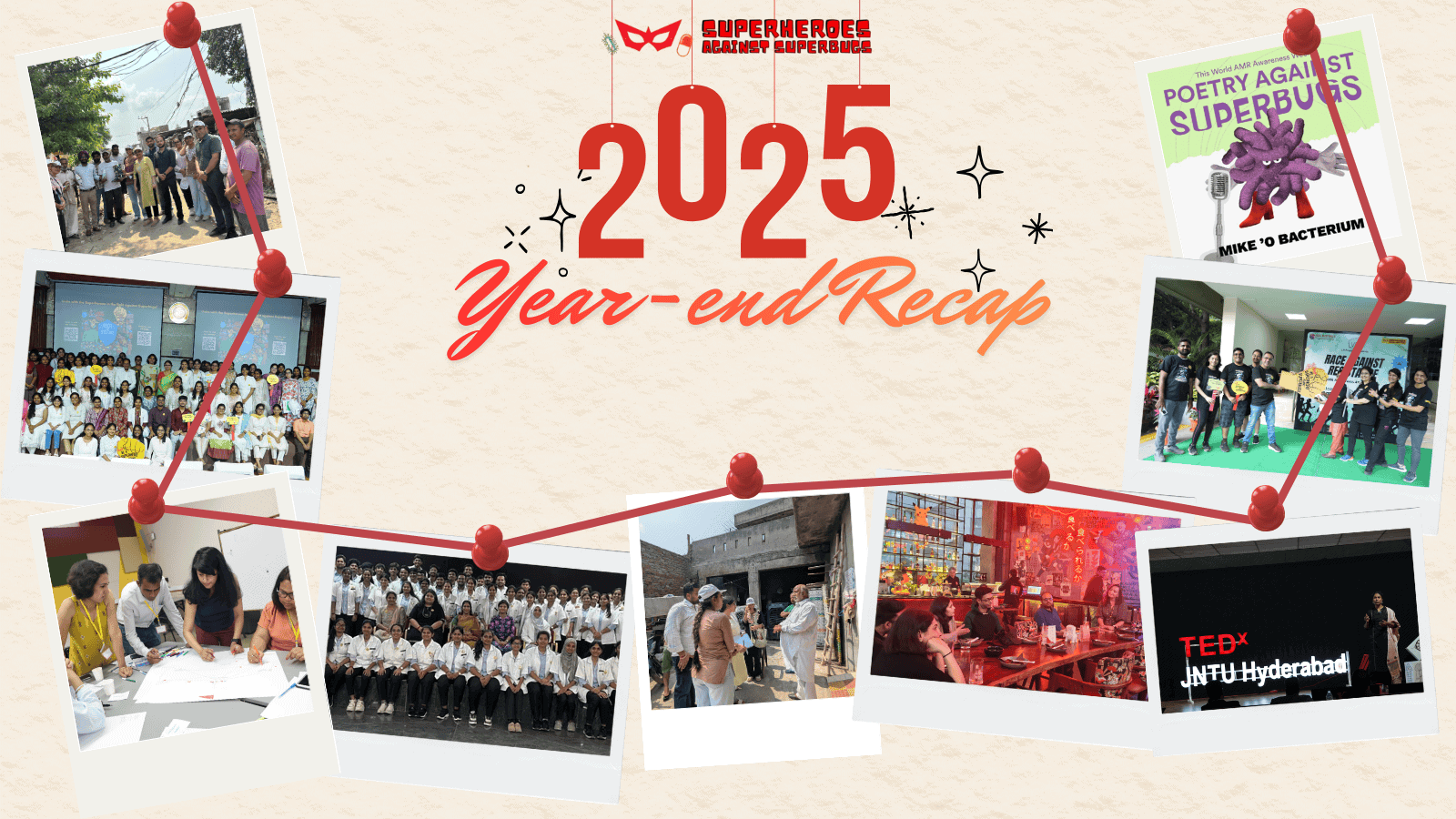
2025 was a year of building depth, widening conversations, and meeting people where Antimicrobial Resistance (AMR) actually shows up! We realise that much of the work in this space still happens in silos. But there are also willing partners and collaborators, who have helped us grow from strength to strength.
Education and capacity building
We worked with medical, nursing, pharmacy, and veterinary students, as well as early-career health professionals, across Mandya, Kolar, Vijayawada, Pune, Bengaluru, Mysore, Ludhiana, Vellore and Hyderabad. In collaboration with academic institutions and hospitals, we used workshops, webinars, discussions, and interactive learning tools to move AMR out of academic textbooks and into everyday clinical, farm, and community realities, where decisions about infection prevention and antibiotic use are actually made.
Alongside this, we released workshop resources for pharmacy students and are working on similar resources for medical and veterinary students to support continued learning beyond these sessions.
Youth engagement
Young people were central to our work. We received the Trinity Youth Challenge grant with CSIR-IMTECH, Chandigarh and GADVASU, Ludhiana, to support youth-led campaigns with veterinary students and farmers. AMR Ambassador Fellowships enabled veterinary students across the country to work with and develop informational material for farmers, schools, and local communities, translating science into practice.
In partnership with Youth Ki Awaaz, we engaged hundreds of young Indians through unique polls that surfaced everyday practices around infections, antibiotic use and grounding AMR communication in lived experience.
In the collaborative spirit, SaS became a member of ReAct Asia Pacific Youth AMR Task Force, which has brought together sixteen youth-serving organizations from the Asia-Pacific region to drive meaningful action against AMR.
Media and science communication
We worked with journalists at the Science Journalists’ Association of India conference to unpack various dimensions of AMR in order to support accurate, responsible reporting on AMR in India.
With support from C-CAMP, LV Prasad Eye Institute, clinicians, scientists and science communicators, we developed interactive infographics, the #KnowYourAbs campaign, and blog content to demystify antibiotics, AMR, and connect everyday choices to wider AMR challenges.
Public and cultural engagement
We took AMR beyond formal institutions and into cultural and everyday public spaces. At the Hyderabad Literary Festival 2025, AMR entered conversations linking science, health and society. With Swissnex India and other partners, we explored AMR through poetry, creating engaging and reflective entry points into a complex issue. This work extended into the streets of Hyderabad through a community awareness run with L V Prasad Eye Institute, a TEDx talk at JNTU Hyderabad and into informal social spaces through conversations over drinks co-organised by Pint of View Gurgaon, reaching audiences who might never attend a health seminar.
Labour, livelihoods, and AMR
We recognise the critical role of farmers and sanitation workers in protecting public health, and the need to safeguard their wellbeing while centring their lived realities. Through work on responsible antibiotic use in dairy farming on the Trinity Challenge project and in collaboration with the South Asian Sanitation and Labour Network (SASLN), we expanded AMR conversations to include farms, sanitation systems, occupational exposure, and environmental contamination. This remains a core area of our work, linking labour, dignity, environment, and public health.
Systems, policy, and practice conversations
Alongside public-facing work, we participated in and helped shape focused workshops and discussions in Chandigarh, Pune, Bengaluru, and Hyderabad with researchers, clinicians, public health practitioners, and programme leaders. These quieter spaces examined AMR surveillance, stewardship challenges, and gaps between policy intent and on-ground practice, helping inform longer-term systems thinking.
Across all of this, one thing remained clear: AMR cannot be addressed in silos. It needs students, farmers, journalists, clinicians, artists, researchers, institutions, and communities in the same conversation.
That’s the work we committed to in 2025 and will continue by bringing AMR-centric stories from communities and turning lived realities into shared learnings and collective action, one conversation and one collaboration at a time.