In our experience, if you want a real sense of how AMR messages are understood outside expert circles, young people are often the best place to begin. With their honesty and imagination, they tell you very quickly what lands, what confuses, and what needs to be rethought. That’s also how our initiative, Superheroes Against Superbugs, began: by co-creating awareness with young people and finding clarity in the questions and perspectives they bring to a problem as complex as AMR.
We recently ran a SolverJam workshop at Reap Benefit’s youth-focussed gathering, SolveCon 2026, in Bangalore – a dynamic space buzzing with young people ready to think, question, and build solutions. It felt like the right place to surface one of the most urgent and still largely invisible public health threats: Antimicrobial Resistance (AMR). For those of us working in AMR education and advocacy, AMR’s siginifcant impact on our health and well-being is quite obvious and urgent. The real challenge has always been to help a wider public see why AMR matters in the first place, especially amid a polycrisis.
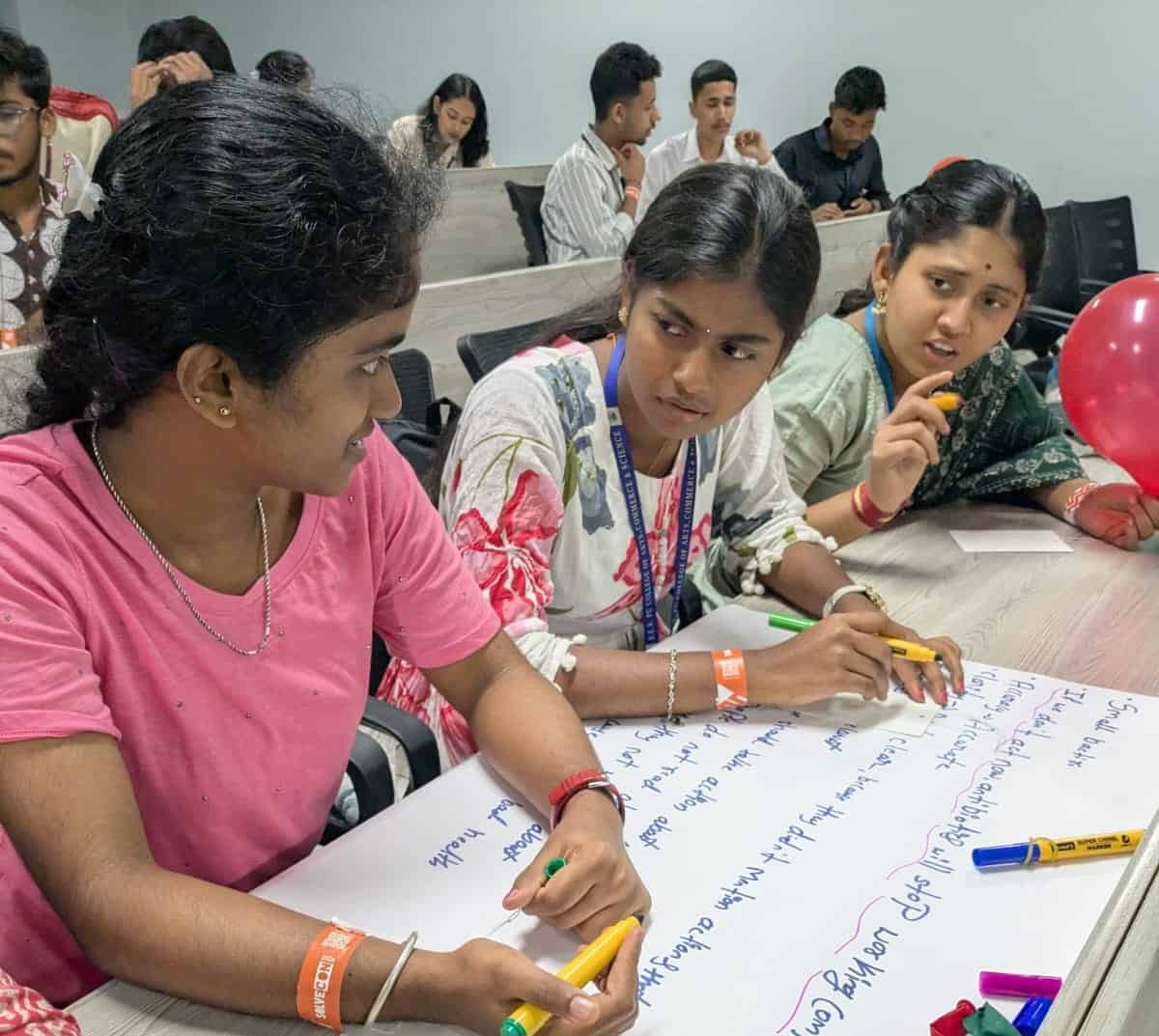
So at this workshop, we started by grounding everyone in the basics of AMR – what is AMR, what’s driving it and what can we do to tackle it. Once the room had somewhat of a shared understanding, we flipped the lens and asked the participants to help us identify where today’s public communication of AMR falls short. Despite the time limitation, they were quick to point out parts in these messages that felt confusing or inaccessible.
It is important to contextualise that our insights in this article come from a small subset of young people, with only a minor proportion having a background in science. We also had participants who weren’t confident in English, even though the session ended up being mostly in English because it was also the only language everyone could follow. That mix made one thing clear right away: we can’t assume any baseline knowledge, and our messaging has to rise above language gaps and technical jargon if we want it to be understood.
The medicine literacy gap is real
When we asked participants to talk about the last time they took antibiotics, a reality check hit us: many young people did not actually know what antibiotics were. To them, there was no distinct difference between an antibiotic and a common medicine like paracetamol. Since both simply “reduce fever” or “make them feel better”, the golden rule of “completing the course” completely missed the mark. As one participant perfectly summed up the general consensus: “Why over-medicate when you are feeling better already?” is a highly logical perspective if you do not understand the underlying microbiology. Even among those who had some awareness, the assumed duration of an antibiotic course ranged wildly from one to three days. This clearly points to an urgent need for foundational medicine literacy before we can even begin to talk about AMR. [We’ve also been tackling this through our #KnowYourAbs campaign on what antibiotics actually are and how to understand them better – more on that here]
The modern “doctors”
At the session, we also briefly explored who advises young people to take antibiotics. While parents and doctors seemed to be the primary sources, ChatGPT appears to have now entered the chat as a modern healthcare consultant, as shared by a participant. Compounding this issue is the widespread availability of antibiotics over the counter in many cities and towns, and the reliance on informal providers, the jhola chhaap doctors common in urban slums and rural areas, who often dispense these medicines without formal medical training. Because antibiotics are so easy to procure without a strict prescription barrier, this combination of informal, easily accessible advice and unrestricted access creates a very smooth route for misuse. [You can read insights from our small study with Youth Ki Awaaz on young people’s behaviour related to AMR]
The jargon disconnect
Perhaps the most striking learning was that the very language we use to describe the problem is a barrier. Throughout our talk and the entire session, while we purposely avoided scientific jargon, whenever we used the words “resistant” or “resistance”, they drew quite a few blank stares or general disinterest. Interestingly, we found that the term “superburgs” was far more intuitive; the young participants could grasp the concept of bugs/germs that have become more powerful.
This disconnect extended to campaign messaging as well. During the group work, participants critiqued common AMR messages and found that vague or technical terms like “bacteria” and “resistant/ce” were unrelatable in public campaign messaging. Broad directives also lacked clarity on how to actually act. For instance, in messages instructing them to “save antibiotics” or “handle antibiotics with care”, participants were left asking what “care” or “responsible” antibiotic use actually looks like in practice. One group also noted that the messages “felt like an order”, without really providing a rationale for it. Compared to anti-tobacco messaging; when people see “no smoking” or “smoking kills”, the reason behind it has been part of the public imagination for a long time. In the case of AMR, that foundational understanding simply isn’t there yet, which means these short messages or slogans will have no impact if we don’t first explain the ‘why’.
It became clear that most AMR campaigns still speak to health-insiders and well-informed, English-speaking audiences, and miss the wider, culturally and economically diverse publics across India.
Finding clarity in translation
Interestingly, we noticed that when the same message was translated into Hindi by some of the participants, it felt much clearer, even to us, than the English version. This might be because the English terminology often relies on Latin-rooted scientific or medical terms, whereas the translations often used more descriptive, grounded language that resonates better with everyday understanding of health and illness. For example, while one group found “bacteria” to be a technical term, the Hindi word “kitanu” (germs) was far more familiar as frequently seen in soap advertisements, making the concept immediately tangible and the overall message a lot more accessible for them.
Our time at this workshop confirmed something obvious: if we want young people to step up as superheroes against superbugs, we can’t rely on just dumping scientific facts at them. We need to begin with the basics of health and medicine literacy, recognise the landscape of healthcare, with AI advice and easy OTC access, shaping their decisions, and rethink our messaging so it’s clear, jargon-free, and immediately useful. And ideally, co-create these messages with the people they’re meant for, in multiple languages, so they feel culturally grounded and genuinely relatable.
With inputs from Somdatta Karak