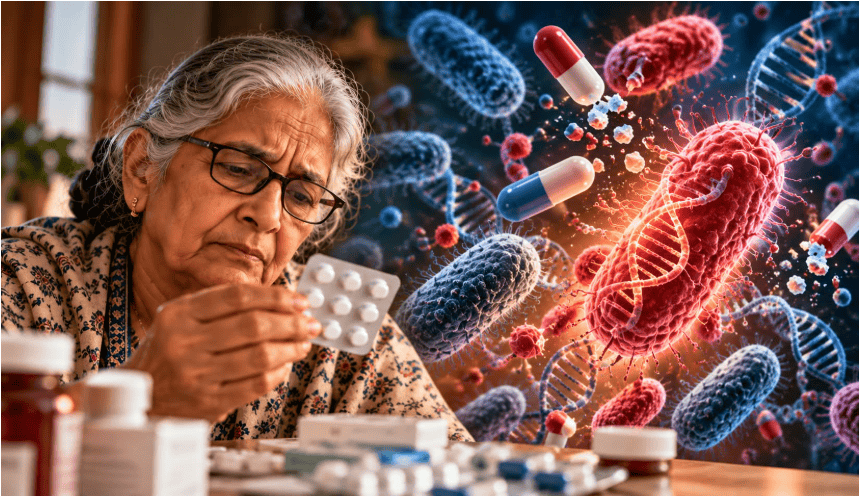
My grandmother has always suffered from gastric problems. Whenever the problem becomes uncomfortable, she visits the doctor, takes the prescribed medicines, and eventually feels better. Over time, she has become familiar with those tablets. Now, when she feels the same problem returning, she takes the medicines again, assuming they would work.
Over the past three to four months, something has changed. The tablets that had worked before seem to have stopped working completely. Her first thought was simple: perhaps the dosage was no longer enough. She increased the dose, but it did not help. Eventually, she consulted the doctor again and was given a new set of medicines.
When she told me this over the phone, I immediately remembered something I had studied in biology: antimicrobial resistance, or AMR. Could resistance explain why a medicine that once worked no longer seemed effective?
Her experience alone cannot prove that AMR was responsible, since gastric problems can have many causes. However, it led me to a much bigger question: how can microorganisms evolve to survive medicines designed to kill them?
The answer lies in evolution.
How do microorganisms become resistant?
We often think of evolution as something that happened millions of years ago. In reality, evolution is happening constantly.
Microorganisms, such as bacteria, are not all identical. As bacteria reproduce, changes called mutations can occur in their DNA. Occasionally, a mutation may give a bacterium some ability to survive an antimicrobial. Bacteria can also acquire resistance genes from other bacteria through horizontal gene transfer.
But having a resistant bacterium is only the beginning. The real change happens when natural selection takes over.
Imagine a population of bacteria in which most are susceptible to an antibiotic, while a small number can survive it. When the antibiotic is used, the susceptible bacteria are killed or inhibited, while the resistant ones survive.
Now the survivors reproduce.
Their descendants inherit the resistance trait, and resistant bacteria can gradually become a larger part of the population. Repeated exposure to an antimicrobial can therefore increase the frequency of resistance in a microbial population.
The antibiotic did not necessarily teach the bacteria to become resistant. Instead, it changed their environment so that bacteria capable of surviving had an advantage. This results in a change at the microbial population level.
This is natural selection happening on a timescale that can directly affect our lives. And, this is where humans become part of the evolutionary story.
Are we helping resistance win?
The existence of variation among microorganisms is natural. What humans can influence is the selection pressure acting on that variation.
Every time an antimicrobial is used unnecessarily or incorrectly, we may create opportunities for resistant organisms to survive and spread. Antibiotics, for example, should not be used for viral infections. We also often use the wrong antibiotic, dose or duration when we self-medicate on them. All of these result in increasing the concentration of antimicrobials in the environment, giving a better chance to the resistant bacteria to thrive.
Are these behaviours actually happening around us? Evidence from India suggests that they are.
A study conducted in Haryana found that antibiotic knowledge among community members was poor. Sixty-five percent of participants believed it was appropriate to stop taking antibiotics once their symptoms improved. The study also found that low income and limited access to qualified doctors were associated with inappropriate antibiotic use. In fact, 85% of participants did not have access to a licensed MBBS doctor in their own village.
It is easy to blame people for these decisions. But the reality is more complicated. When visiting a doctor is expensive or requires travelling long distances, buying medicines directly from a pharmacy can become the easier option.
There is another factor we often overlook: the influence of family.
Health-related behaviours are not always newly learned by each generation. They are often passed down through everyday conversations and experiences at home. If an older family member has spent years reusing an old prescription, taking medicine whenever familiar symptoms appear, or stopping treatment once they feel better, younger family members follow the same.
This creates a challenge for science communication. Many health-awareness programmes focus strongly on children, students and young adults because they are important audiences for long-term behavioural change. But older adults are also important sources of health knowledge within families. If they are left out of the conversation, familiar practices can continue across generations, even when younger members receive better information elsewhere.
This does not mean older people are responsible for AMR. Rather, it shows that changing behaviour requires reaching the people who influence everyday decisions, regardless of age.
The problem is not limited to families or rural communities either. A study among students and teachers in New Delhi found poor understanding of antibiotics, including their use for mild or viral conditions, use of leftover medicines and obtaining antibiotics directly from pharmacies. Poor doctor–patient communication was also identified as an important factor.
The issue becomes even bigger when we look beyond humans.
A recent study from rural South India identified untreated water, open defecation, poor drainage and irregular waste collection as conditions that can help maintain environmental reservoirs of resistant bacteria. Financial and transport barriers also affected healthcare decisions.
Animals are part of this story too. Antibiotic use in livestock can select for resistant bacteria in animals. Through human–animal contact, animal waste, water and the environment, resistant bacteria and resistance genes can move between these connected systems.
This is why AMR is not simply a problem of one person taking one tablet. It is a One Health problem involving humans, animals and the environment.
What should we change?
The answer is not to stop using antibiotics. Antibiotics save lives when they are genuinely needed. The goal is to use them appropriately and avoid creating unnecessary selection pressure.
Before taking an antibiotic, we should ask whether we actually need one. Antibiotics do not treat viral infections, so taking them for a viral illness provides no benefit against the virus.
When an antimicrobial is needed, the appropriate drug, dose, route and duration should be determined by a qualified healthcare professional. We should not increase the dose ourselves simply because the medicine seems less effective, reuse an old prescription, or take someone else’s antibiotics. But responsible behaviour cannot depend only on individuals.
People need affordable healthcare, accessible doctors, reliable diagnostics and clear communication. Communities need better antibiotic education, and that education needs to reach across generations, not only young people. Pharmacies and healthcare providers need responsible prescribing and dispensing practices.
At the same time, vaccination, hand hygiene, safe food, wound care, clean water and sanitation can prevent infections and reduce the need for antimicrobials in the first place.
I began with my grandmother’s simple question: why did a medicine that once worked stop working?
I discovered that the answer could involve something much bigger than the medicine itself.
Evolution is happening around us and inside us. Microorganisms vary, reproduce and face selection. When we use antimicrobials, we can change the environment in which they evolve.
We cannot stop microorganisms from evolving. But we can stop unnecessarily helping resistance win.
And perhaps the next time a medicine seems to stop working, instead of asking only, “Do I need a stronger dose?”, we should ask a more important question:
“What is happening to the microbes?”
Divya Nayak is an undergraduate student at Ashoka University, pursuing a B.Sc. (Honours) in Biology. She has a strong interest in Ecology, Evolution, and Bioinformatics, with a particular curiosity about how biological systems interact with their environment and evolve over time. She is keen to explore research-oriented careers and hopes to contribute to scientific research through interdisciplinary approaches to biology.