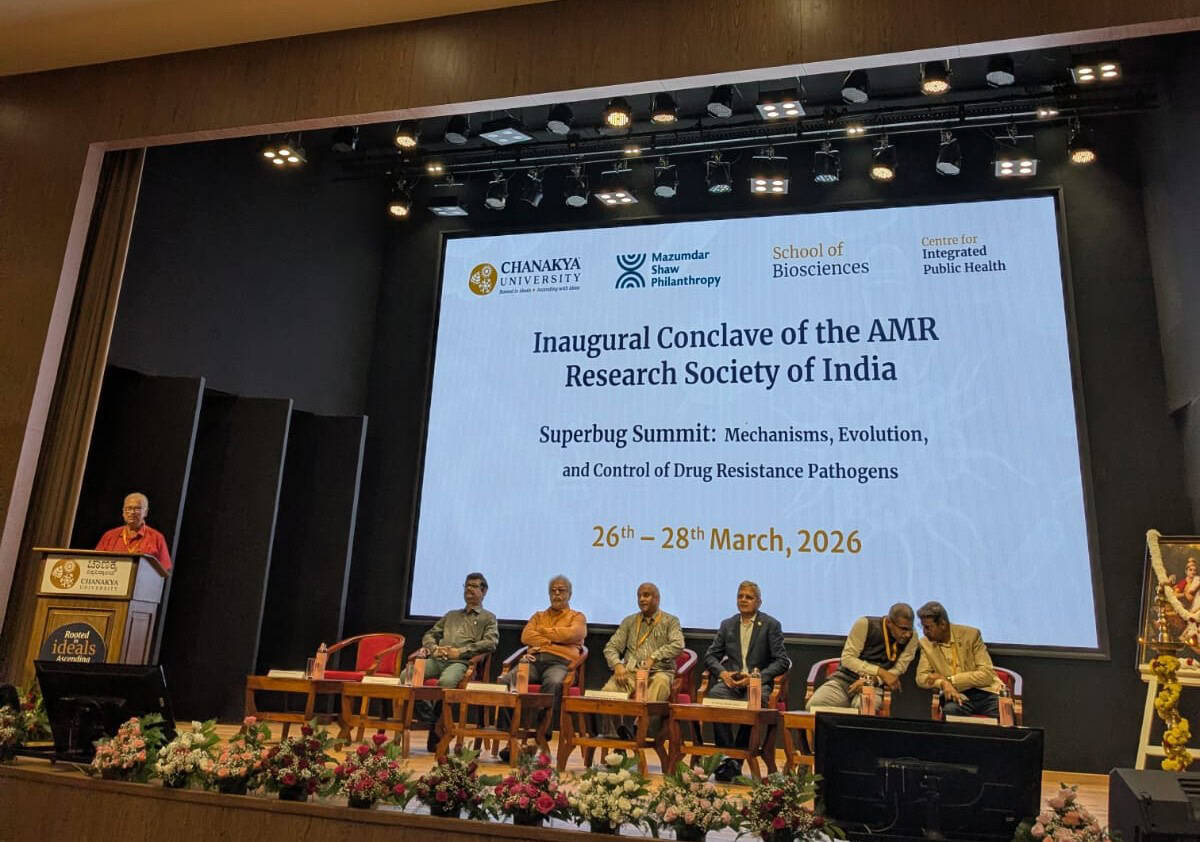
The Superbug Summit 2026: Mechanisms, Evolution, and Control of Drug-Resistant Pathogens, at Chanakya University, Bengaluru, was a timely reminder of just how vast the AMR challenge really is – stretching from the microscopic mechanics of microbial evolution to the messy realities of drug pipelines, health systems, policy gaps, and everyday human behaviour. Over three days (26–28 March 2026), scientists, clinicians, policymakers, and industry representatives gathered for what turned out to be a rich, if sobering, conversation.
The science is advancing. But the problem isn’t waiting.
The scientific sessions were a masterclass in why AMR refuses to be a simple story. Microbes adapt, persist, and outsmart pharmaceutical interventions with remarkable ingenuity, and the pathways through which resistance spreads are far broader than most people assume. One striking example: environmental pollutants like heavy metals or even detergents can trigger bacterial stress responses that accelerate the spread of antibiotic resistance genes. AMR, in other words, isn’t just a hospital problem. It lives in our water, our soil, our supply chains.
Diagnostics featured prominently in the discussions too. The inability to rapidly distinguish between viral and bacterial infections at the point of care remains one of the most frustrating bottlenecks in the field, and one of the most consequential. Without reliable tests, clinicians default to antibiotics. It’s an understandable response to uncertainty, but it compounds the problem.
Drug discovery sessions were candid about the economics. Developing a new antibiotic takes over a decade, carries high failure rates, and offers weak financial returns. Yet promising work is emerging from smaller research groups and SMEs trying to rethink the model. The pipeline isn’t empty, but it isn’t reassuring either.
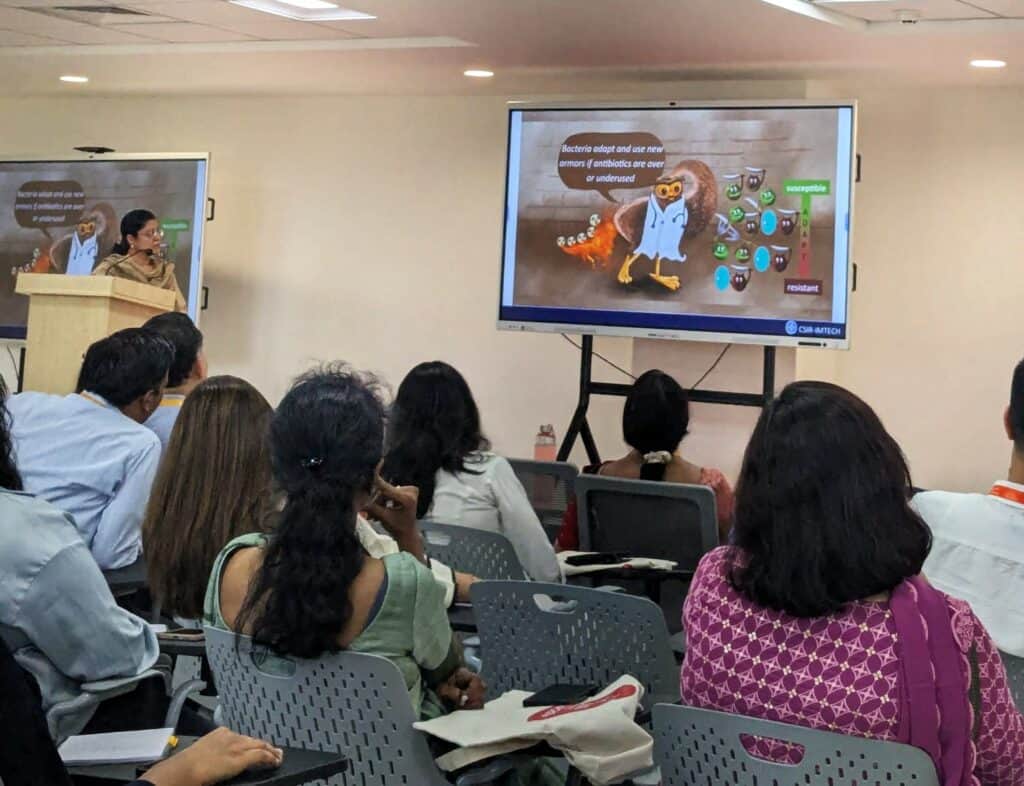
One genuinely encouraging thread was the involvement of young researchers throughout the meeting. Poster sessions, flash talks, and open discussions gave early-career scientists real space, not just performative inclusion, and the energy they brought to cross-disciplinary thinking was palpable.
From evidence to practice: where things get complicated
The panel discussions were where the meeting got real. A frontline clinicians panel, moderated by Dr Vidya Ramesh (Aakash Hospitals), with Dr Kavya (Rashtrothana Hospitals), Dr Sandeep Reddy (Ramaiah Hospitals, Bengaluru), Dr Prasan Shankar (The University of Trans-Disciplinary Health Sciences and Technology, Bengaluru), and Dr Sunitha C. Srinivas (Rhodes University; Indian Pharmaceutical Association), surfaced a tension familiar to anyone who has worked in healthcare: treatment decisions are shaped by urgency, not guidelines.
Clinicians must often act before diagnostic certainty is possible, navigating the gap between genotypic and phenotypic resistance in ways that antibiograms alone can’t resolve. The panel was refreshingly practical, with hospital leadership involvement in antibiotic use reviews and stronger infection control practices flagged as unglamorous but achievable starting points. An interesting detour into Ayurvedic practice added nuance: resistance can emerge in response to any antimicrobial exposure, herbal or pharmaceutical. The pace may differ; the principle doesn’t.
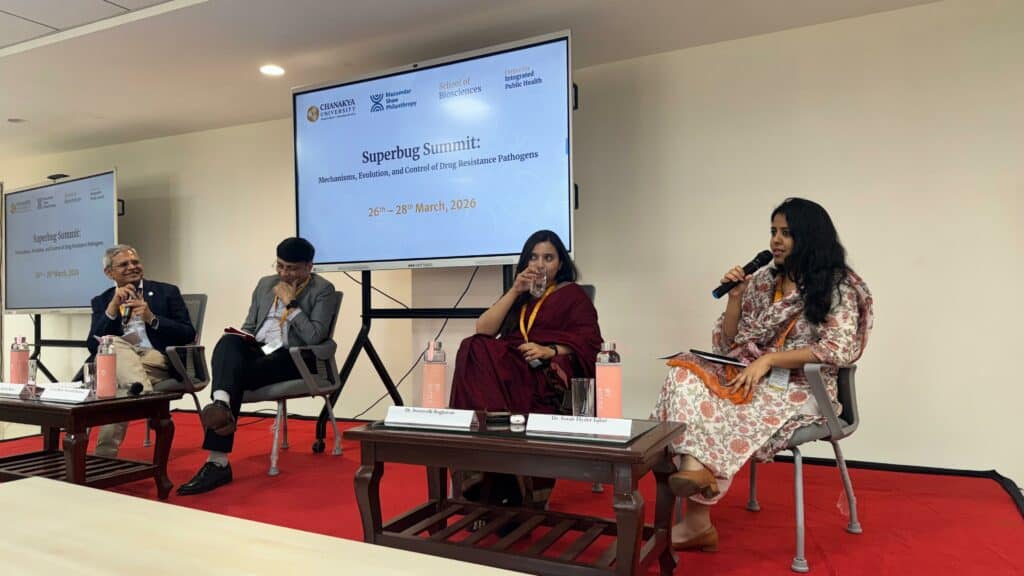
A second panel, moderated by Dr Ranga Reddy Burri (Infection Control Academy of India, IFCAI, Hyderabad), with Dr Swetavalli Raghavan (Advisor on AMR, Government of Karnataka), Dr Sarah Hyder Iqbal (Superheroes Against Superbugs), and Dr Somnath Banerjee (Project Concern International, New Delhi) examined the distance between AMR commitments on paper, national and global action plans, and what actually happens on the ground.
The central frustration was accountability: who, ultimately, is responsible for AMR outcomes? Kerala was held up as a useful model, though the panel was careful to note that what works in one state doesn’t automatically translate elsewhere, given the persistent tensions between state and central health governance. The more unsettling observation was this: the burden of antimicrobial stewardship continues to fall disproportionately on those with the least power to change the system.
A new platform for a fragmented field
The final day brought something concrete: the inaugural conclave of the Antimicrobial Resistance Research Society of India (AMRRSI), launched as a platform to connect research, policy, and practice across sectors.
A high-level panel moderated by Prof Rishikesh Pandey (IIT Roorkee) and Dr Sarah Hyder Iqbal (Superheroes Against Superbugs), with Dr Ranga Reddy Burri (IFCAI, Hyderabad), Dr Maneesh Paul (Orchid Pharma, Bengaluru), Prof Umesh Varshney (Indian Institute of Science, Bengaluru), Dr Radha Rangarajan (CSIR-Central Drug Research Institute, Lucknow), Dr Sindhura Ganapati (Office of the Principal Scientific Adviser, Government of India), and Dr Santasabuj Das (ICMR-NIRBI, Kolkata) followed, tackling the structural challenges at the science-policy-industry interface, including the perennial question of whether to prioritise new antibiotic development or double down on infection prevention, and how to better integrate the human, animal, and environmental dimensions of AMR under a genuine One Health framework.

Across all the panels, a few questions kept surfacing: Why hasn’t the expansion of surveillance translated into measurable changes in prescribing? What keeps infection prevention and control measures from being implemented consistently? And are we too focused on healthcare settings while the real drivers, agriculture, wastewater, the environment, go relatively unaddressed? How is the research progressing on these fronts?
The problem isn’t knowledge, it’s the will to change.
That, really, is the meeting’s bottom line. AMR is not only a scientific challenge, it is a systems challenge, shaped by governance structures, misaligned incentives, infrastructure gaps, and behaviour across multiple levels. The science is maturing, yes. Genomics, diagnostics, surveillance, drug discovery: the tools are improving. But translating that knowledge into consistent, coordinated action remains the hard part.
Most of what needs to happen is already understood. The question is whether the institutions, incentives, and systems in place are genuinely willing and able to act on it. Platforms like AMRRSI, if they can hold together the right mix of researchers, policymakers, and practitioners, have a real opportunity to catalyse exactly that.
Working in AMR? AMRRSI is worth looking at: amrrsi.org