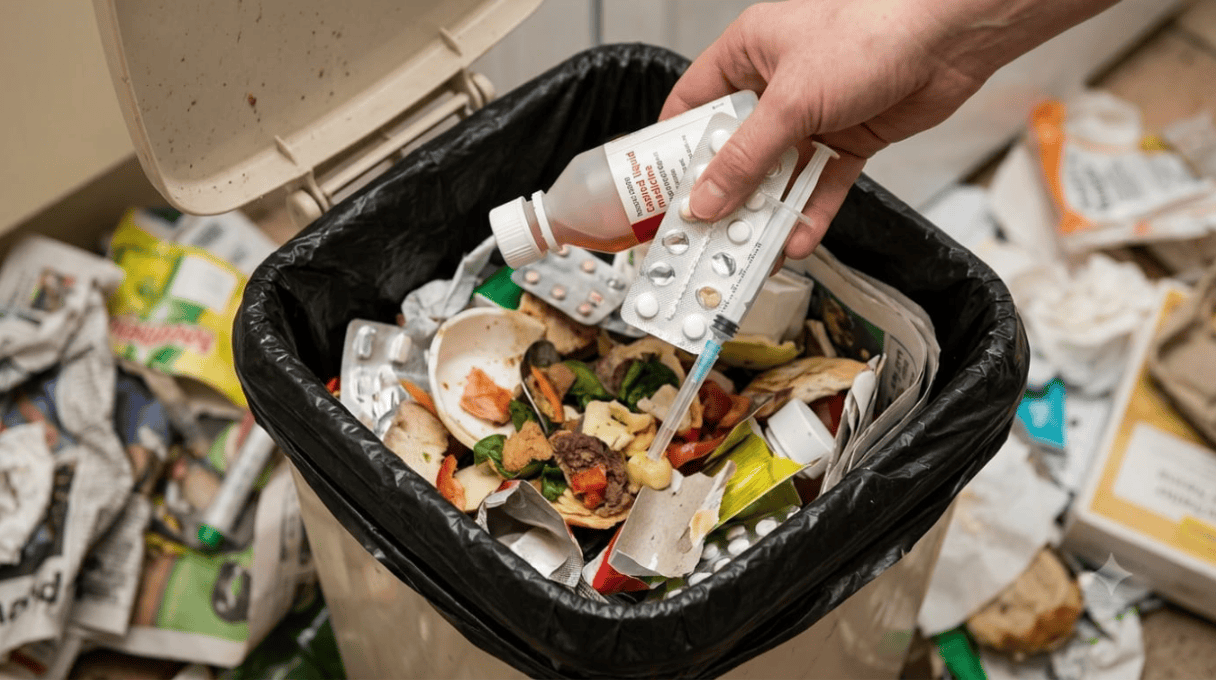
As a life sciences student who has been around medicine my whole life, I’ve noticed a troubling reality: household waste disposal of medicines is a major, ignored driver of antimicrobial resistance (AMR). While AMR poses a threat on par with global pandemics, most households treat unused antibiotics as standard trash. In India, we have guidelines for almost everything, and waste disposal is not an exception. Yet basic implementation consistently falls short—we still struggle to get households to segregate daily wet and dry waste despite decades of awareness campaigns. If proper waste segregation isn’t a routine habit yet, getting people to safely dispose of unused medicine will be an even steeper uphill battle.
Where the surplus comes from
Start with how medicine actually reaches people. When my parents, or others I know, visit a hospital — especially a government one — the pharmacy counter often hands over a full ten-tablet packet, even when the doctor only prescribed a three- to five-day course. Patients, for their part, often ask for medicines for ailments they don’t currently have — a cough, a cold, a headache — specifically so they’ll have “buffer” medicine at home for whenever someone falls sick next.
A lot of this traces back to access. In rural areas, the nearest hospital may be far, and even where one exists, commuting is a barrier. There’s also a gendered layer to it: unless it’s an emergency, a woman is often not permitted to go to the hospital or see a doctor herself. She takes whatever backup medicine is already at home, or she describes her symptoms to her husband, who then decides what to bring back — from a doctor or, just as often, straight from a medical store.
Underneath all of this is a shaky understanding of how medicines actually work. The moment someone starts feeling better, they stop the course — the rest of the prescription sits unused. I’ve seen people take medicine even in the worst conditions, combining things that were never meant to be combined. My maternal grandmother used to take eight tablets in one sitting, self-prescribed — a headache, leg pain, low blood pressure, and shoulder pain, all treated at once with combining analgesics, antihistamines, antacids, and blood pressure medications—stopping only when they feel temporary relief. That’s one example, but the pattern repeats: expensive medicines get rationed and left incomplete because of financial constraints, while cheap medicines invite a different problem — the assumption that if something worked for illness X, it’ll work for Y too.
Convincing households to throw away unused, unexpired medicine—purchased with hard-earned money—is extremely difficult. Second, the lack of AMR awareness means people do not connect improper disposal with environmental contamination or drug resistance. Third, even when individuals understand the risk, there are virtually no accessible systems or incentives for separate pharmaceutical disposal.
Either way, the household ends up holding onto medicine it was never going to finish.
Why that surplus becomes a disposal problem
This is the part that connects the two issues. That leftover stock doesn’t disappear — it sits in a drawer until someone eventually clears it out, and when they do, there’s no concept of antibiotic disposal in the surroundings I’ve seen. It gets thrown out with the regular household waste, the same way any other trash would be.
The first challenge is convincing anyone that unfinished, unexpired medicine — something they paid for with money that wasn’t easy to earn — should be thrown away at all. The second is that most people have no idea AMR exists, partly because doctors in rural India often prescribe similar combinations of medicines across different complaints. This can include painkillers, paracetamol as well as antibiotics. Just like painkillers and paracetamol, antibiotics are also expected to work all the time. The third challenge is that even where people understand the reasoning, there’s little incentive to sort and dispose of medicine separately from everything else — especially in communities where basic literacy is already a barrier to understanding the “why.”
To bridge this gap, India could leverage reward-based deposit schemes. Similar to blood donation drives—where organizers frequently offer tangible tokens like helmets, dinnerware sets, refreshment kits, or small travel allowances to encourage participation—medicine return programs need concrete incentives. Implementing reverse-vending machines or hospital return counters that offer OPD fee waivers or pharmacy discount vouchers could transform disposal habits. Also, countries like Germany, Norway, Finland already use reverse-vending machines for recycling plastic bottles, where you deposit the item and get a token or credit back. The same model could work for a machine that accepts leftover or expired medicine.
The real bottleneck
None of this is free. There’s a real cost, time, and communication gap running through all of it. And in India, the underlying habit — holding onto leftover medicine “just in case” — is deeply practiced. So, the honest question isn’t just “dispose it properly or not” — it’s whether people even believe there’s a cause-and-effect here at all. Do they know what AMR actually is? Until we address the common suspicion that doctors ask us to toss unused medicines just to make us spend more money on future visits, there’s no real audience for questions like where to dispose of medicine, or how to take the correct dose in the first place.
The hoarding and the disposal aren’t two separate failures — they’re two ends of the same broken chain: limited access creates surplus, surplus sits unused, and an absent disposal culture lets that surplus become an environmental and public health hazard. Fixing one end without addressing the other won’t hold.
Akshay Bansal is a 4th year integrated masters student in life sciences at Ahmedabad University, Ahmedabad. The author comes from a rural background, a small village named Hirapur in Haryana. In this article he tried to share the views of how rural India sees AMR. His perspective is shaped by his grassroots upbringing and close connection to rural life.