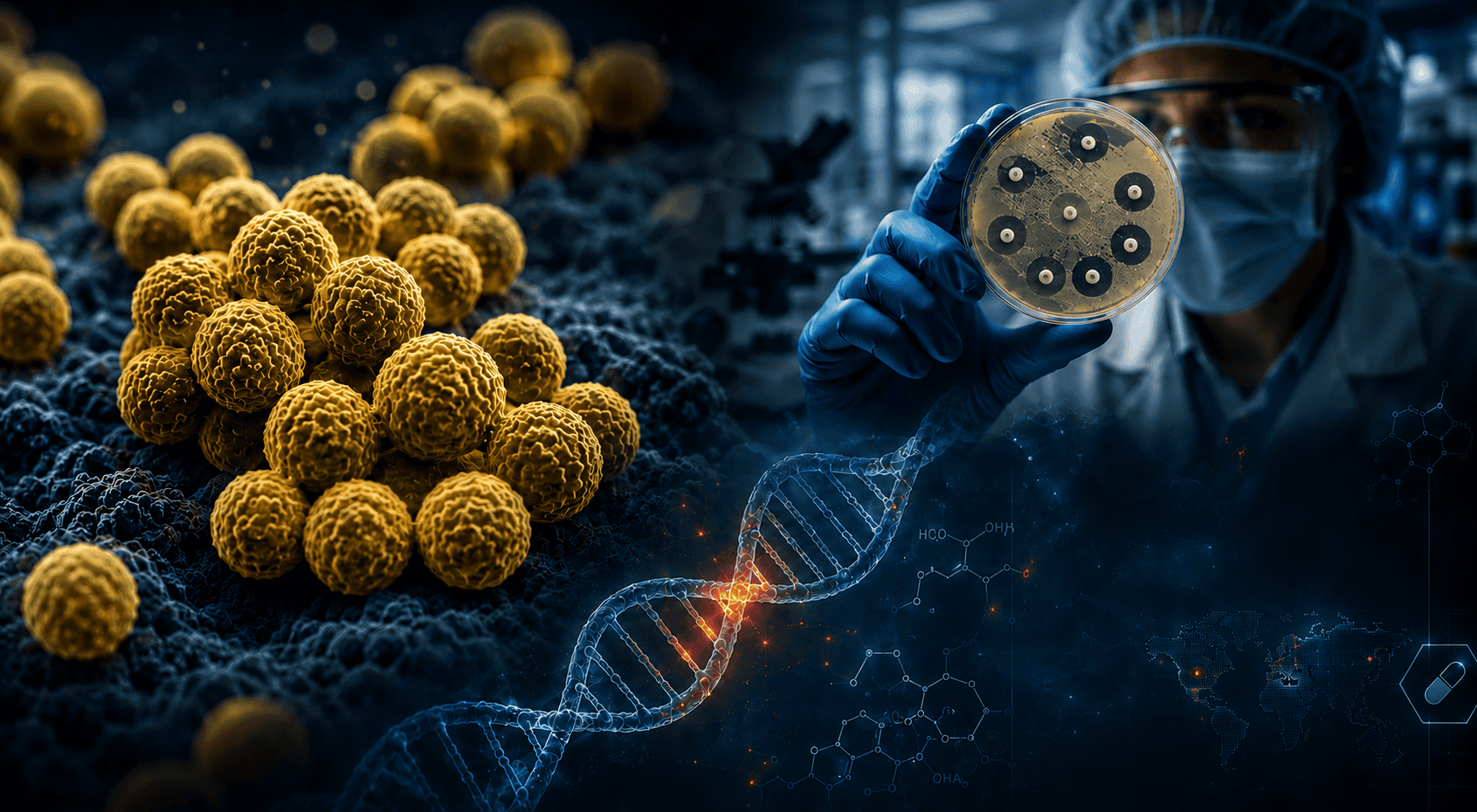
What if someone told you that “not all dangerous bacteria come from outside, some may already be living on your body?” Surprising as it may sound, it’s true.
One of the world’s most notorious superbugs may already be living on your skin or in your nose. Meet Staphylococcus aureus (S.aureus) – a common human colonizer that peacefully inhabits the skin and nasal passages of many healthy people.
So how does this seemingly harmless companion transform into one of the most feared antibiotic-resistant pathogens in modern medicine? That’s the story of MRSA (Methicillin-Resistant S. aureus).
Meet the microbe
The story of this tiny, spherical bacterium, often seen under the microscope as grape-like clusters, began in 1880. A Scottish surgeon, Alexander Ogston first isolated it from a surgical wound. Today, we know that S. aureus is much more than a pathogen. It commonly inhabits the skin and nasal passages of healthy people, quietly coexisting with its human host. Because its presence usually causes no symptoms, most carriers never realize it’s there.
But what is a bacterium doing inside our nose in the first place? Rather than being a passive resident, S. aureus is an active member of a much larger microbial community. It competes with neighboring microbes for space and nutrients and produces chemicals that help to establish and defend its territory. Most of the time, this peaceful coexistence benefits the bacterium without harming us as the host body provides it with nutrients and a comfortable space. However, that balance doesn’t always last.
When a quiet neighbor turns opportunist
There’s a saying: “Strike while the iron is hot.” In many ways, that’s exactly how S. aureus behaves. Most of the time, it coexists peacefully with us. But the moment an opportunity to invade arises, it doesn’t hesitate to take advantage of it, transitioning from a harmless colonizer to a pathogen. That’s why scientists describe it as an opportunistic pathogen – a microbe that usually lives harmlessly on or within the body but can cause disease when our natural defenses are weakened.
Our first line of defense is the skin, which acts as a physical barrier against invading microbes. However, a cut, surgical incision, or the insertion of a medical device such as a catheter can create a breach in this protective wall. For S. aureus, these openings are an invitation when immunity is weak. The bacterium attaches to damaged tissues, invades them, and begins to multiply. It can also form sticky communities called ‘biofilms’ on medical devices, allowing it to persist, evade the immune system, and sometimes even resist antibiotic treatment.
Once inside the body, what began as a harmless companion can become a dangerous invader, causing a wide range of infections – from minor skin boils to pneumonia, bloodstream infections, and life-threatening sepsis.
The evolution of resistance
As if taking advantage of weakened defenses wasn’t enough, S. aureus developed another remarkable survival strategy: learning to outsmart antibiotics or antibiotic resistance.
The first-ever antibiotic, Penicillin, revolutionized medicine. Its introduction during world war II decreased the deaths due to bacterial pneumonia and meningitis. But by 1945, almost 80% of bacteria isolated from patients became resistant. So, when resistance spread, scientists developed another antibiotic, methicillin, as the next line of defense. It seemed like victory, until just two years later, the first Methicillin-Resistant S. aureus or MRSA strain was reported in the United Kingdom. The battle had only just begun.
So how did MRSA achieve this remarkable feat?
Unlike penicillin resistance, methicillin resistance came from borrowing a new genetic tool. S. aureus acquired a resistance gene (a piece of DNA that helps survive in the presence of antibiotics) called mecA from another species of staphylococcus. This gene arrived inside a mobile piece of DNA known as the staphylococcal cassette chromosome mec (SCCmec) – almost like a delivery truck carrying a new survival kit from one bacterium to another.
Normally, methicillin kills bacteria by binding to proteins that build the bacterial cell wall. The mecA gene instructs MRSA to produce a modified version of one of these proteins, called PBP2a. Because methicillin can no longer recognize or bind to this altered protein, the bacterium continues building its protective cell wall even in the presence of the antibiotic. The drug that once promised victory is suddenly rendered ineffective.
Why MRSA matters
With all the advances in modern medicine, one question remains: Why does MRSA still matter?
Once regarded mainly as a hospital-associated pathogen, MRSA was largely confined to patients undergoing surgery, using catheters, or with weakened immune systems. However, it has since escaped the hospital walls. Today, community-associated MRSA (CA-MRSA) causes infections in otherwise healthy people with no recent history of hospitalization, making it a concern both inside and outside healthcare settings.
More importantly, MRSA is a symbol of the growing crisis of antimicrobial resistance (AMR). But this raises the obvious question: Why not simply use other antibiotics? The problem is antibiotic resistance doesn’t stop at a single drug. MRSA can also acquire resistance to other antibiotics, leaving doctors with fewer and less effective treatment options. As bacteria continue to evolve against our antibiotics, infections become increasingly difficult to treat, prolonging hospital stays and increasing the risk of severe disease and death.
Recognizing its global impact, the World Health Organization continues to identify methicillin-resistant Staphylococcus aureus as a high-priority bacterial pathogen for research and public health action. MRSA is also one of the ESKAPE pathogens – a group of bacteria named for their remarkable ability to “escape” the effects of antibiotics. Together, these pathogens are responsible for many of the world’s difficult-to-treat healthcare-associated infections and represent one of the greatest challenges to modern medicine.
How do we fight back?
Although S. aureus has evolved into a superbug, it is not invincible. Suspected MRSA infections are diagnosed by collecting samples such as blood, pus, wound swabs, or nasal swabs and testing them in the laboratory to identify the bacterium and determine which antibiotics will be effective.
Preventing MRSA begins with simple but effective measures. Regular hand hygiene, proper infection prevention and control in hospitals, and careful cleaning of medical equipment help reduce its spread. Equally important is the responsible use of antibiotics. Antibiotics should only be taken when prescribed, at the correct dose, and for the recommended duration. Misusing or overusing antibiotics gives bacteria more opportunities to evolve resistance, making future infections harder to treat. Protecting antibiotics today means protecting lives tomorrow. Continuous surveillance helps detect resistant strains early and monitor outbreaks, while researchers are developing new antibiotics, vaccines, and alternative therapies to stay ahead of MRSA.
Every day, we coexist with trillions of microbes. Most are harmless, many are helpful, and a few can become dangerous when circumstances change. MRSA reminds us that the greatest threats aren’t always strangers, they can be familiar companions shaped by evolution and our own improper use of antibiotics.
Niveditha A M is a first year PhD student in Infection Biology at NCBS, Bengaluru. Her research explores the complex interactions between Mycobacterium tuberculosis and the host immune system. She is also passionate about making infectious disease research accessible to the public through science communication.