Much of the communication around Antimicrobial Resistance (AMR) focuses on what individuals should or should not do: use antibiotics responsibly, practise good hygiene, and seek medical advice when unwell. While these messages are important, they also raise a difficult question: What does responsible behaviour mean when people do not have the resources or conditions that allow them to act on that advice?
For someone who cannot afford to lose a day’s wages to visit a doctor, works in conditions that increase their exposure to infections, or struggles to access affordable healthcare, decisions about medicines are rarely straightforward. Yet these realities, and the people who experience them, are often missing from conversations about AMR.
On 21 October 2026, Superheroes Against Superbugs (SaS), the South Asian Sanitation Worker and Labour Network (SASLN), and Partners in Change (PiC) came together for an online conversation which brought together community conveners working with sanitation worker communities and three invited health experts to reflect on what happens when we begin understanding AMR through people’s everyday experiences rather than starting with scientific messages we want to communicate.
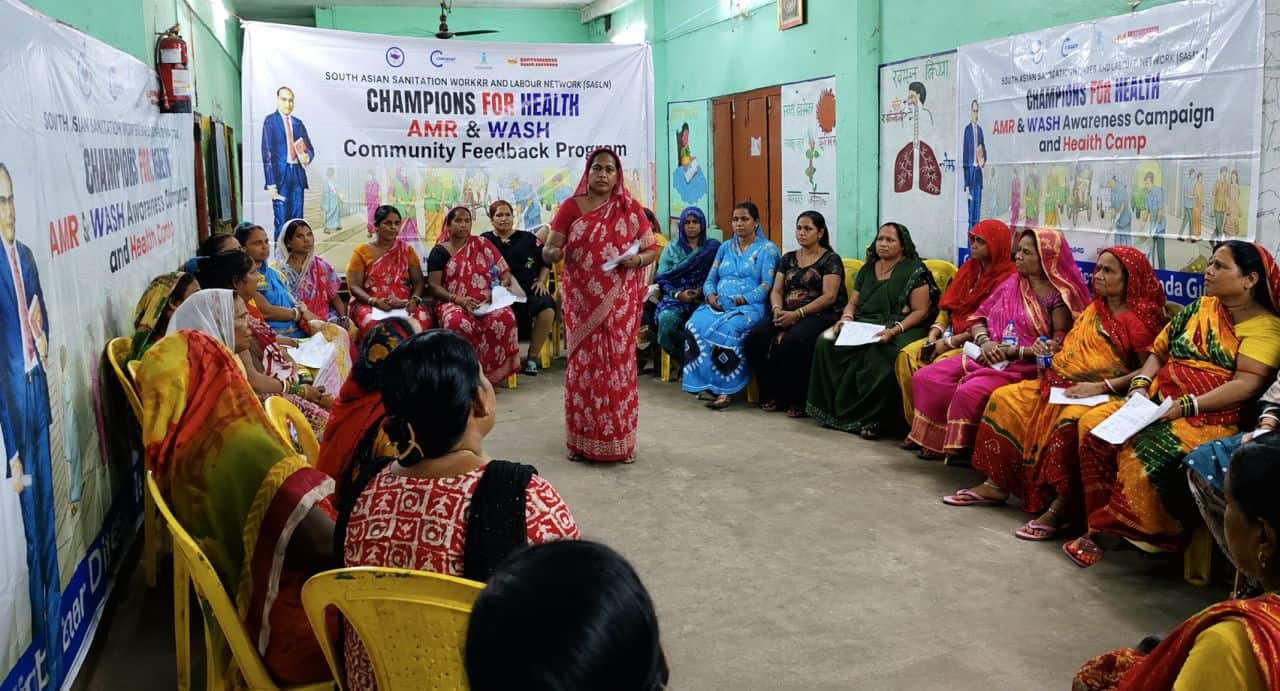
The conversation drew on Sehat Ke Rakhwale (Champions of Health), a collaborative project that engaged over 3,000 sanitation workers and their families through health camps, community discussions, youth workshops and other activities across Assam, Chandigarh, Punjab, Uttarakhand and West Bengal. The project explored how AMR intersects with water, sanitation and hygiene (WASH), occupational risks, healthcare access, caste and other social circumstances. The learnings and insights from the project formed the basis of this conversation.
But the webinar, which was conducted in Hindi and English, was not simply an opportunity to present what the project had achieved but rather, it was a space to reflect on what we had learned, what had challenged our assumptions, and what might need to change in how we approach AMR.
Looking beyond individual behaviour
Opening the discussion, Dr Sarah Hyder Iqbal from SaS reflected on how the collaboration had challenged their own approach to AMR communication and public engagement. While awareness and responsible antibiotic use remain important, the project has prompted a shift towards examining the circumstances that shape people’s ability to make health-related decisions. It also raised questions about why caste, occupation, working conditions and power relationships receive so little attention in mainstream AMR communication, despite their influence on infection risks, disease prevention, and access to care.
What does it actually mean to take community knowledge seriously, not simply to listen to people’s experiences or use them to make our communication or engagement more relevant, but to allow these experiences to challenge how we understand AMR, the kind of questions we’re asking, and also the priorities we set?
Pradeep Narayanan from Partners in Change situated this work within the idea of a place-based just transition, arguing that communities should be recognised as citizens and agents of change, rather than simply as consumers expected to modify their behaviour. This means creating opportunities for communities to investigate problems, question institutions and engage directly with scientists, healthcare providers and policymakers.
These ideas became particularly tangible through the reflections shared by SASLN colleagues based on their experience of working with their communities.
Kamaljeet Kaur illustrated the challenges through the story of Manpreet, a sanitation worker who falls ill but continues working because taking leave would mean losing wages. Seeking medicines directly from a pharmacy may appear to be an example of inappropriate medicine use, but the decision looks very different when viewed alongside financial pressures, limited time and difficulties accessing healthcare.
Dinesh Hela highlighted another important learning: gaps in AMR understanding were not confined to communities. Conversations also revealed gaps among some doctors and pharmacists, raising questions about the limitations of interventions that focus primarily on educating patients while overlooking the practices of healthcare providers.
For Megha Singh, one of the most significant lessons concerned how sanitation workers’ knowledge was recognised.
Sanitation workers are not merely beneficiaries. They are important knowledge holders, with valuable insights into their own health, working conditions, and communities.
Yet their experiences are not always taken seriously within healthcare settings. Caste and occupation further shape how their health concerns are perceived and addressed. This prompted a change in the questions being asked. Rather than only explaining AMR, the teams began asking people about their health concerns, occupational risks and experiences of seeking treatment.
Seema Sapriban described how health camps and community meetings became opportunities for two-way conversations. Women, young people and sanitation workers shared their experiences and asked questions about antibiotics, infections, hygiene and workplace safety. These interactions reinforced that participation means more than attending an activity; it involves having the opportunity to contribute knowledge and influence the conversation.
Participation is not simply about attending a meeting or marking one’s presence.
Bringing these reflections together, Vikesh Kumar, emphasised that AMR cannot be separated from access to clean water, safe working conditions, affordable healthcare and environmental risks. He also posed an important question for those designing community engagement programmes: Rather than asking only how many people we informed about AMR, should we not also ask how many people we listened to, and whether their experiences influenced our work?
What did the discussion mean for AMR research and practice?
The community reflections were followed by responses from three invited discussants, each bringing a different perspective to the implications of this work.
Dr Ranga Reddy Burri, President of the Infection Control Academy of India, spoke candidly about how the discussion had broadened his own understanding of AMR. He observed that AMR discussions often concentrate on clinical, microbiological and technical questions, while the social circumstances shaping antibiotic use, infection risk and healthcare access remain peripheral.
Awareness alone is not enough. We cannot expect people to make responsible choices if the systems make those choices difficult or impossible.
He argued that sanitation workers should be recognised not merely as beneficiaries of public health programmes but as important public health actors and knowledge holders.
The real test of our AMR response is not only whether antibiotics are used appropriately. It is whether people can prevent infections, access appropriate care, work safely and live with dignity.
Dr Vrinda Nampoothiri, a clinical pharmacist and researcher at Amrita Hospital, drew attention to what AMR research tends to measure. While antibiotic consumption, prescribing appropriateness and treatment outcomes are important, these indicators do not necessarily explain why people make particular decisions about medicines. For instance, when patients do not follow a prescribed treatment, how often do we investigate whether the reasons involve lost income, unaffordable care or medicines being unavailable at health facilities?
Here in this study, I see that the community members have actually become the change leaders, which to me is a very impactful part of the work.
However, she noted that such shifts in understanding, ownership and everyday conversation may be difficult to quantify, but they deserve greater attention in AMR research and engagement. She felt there needs to be more opportunities for community researchers and healthcare professionals to learn directly from one another.
Dr Deepshikha Batheja, Principal Research Scientist at the Indian School of Business, approached the work through the lens of social and economic inequalities and just transitions.
She described the project’s participatory approach as an important contribution to epistemic justice, which asks whose knowledge is recognised, how knowledge is produced, and who gets to contribute to its interpretation. She emphasised the importance of understanding how caste, gender, income and occupation intersect to shape people’s exposure to infections and their healthcare decisions. She also appreciated the idea of AMR Connectors, who can bring together communities, institutions and different sectors to enable continued dialogue and collective action.
Importantly, she argued that these insights should find their way into policy conversations, including national and state action plans on AMR, and into primary and community healthcare, rather than remaining confined to specialist hospitals or research reports.
Travelling the last mile first: What comes next?
A common thread across the discussion was that communities should not be the final destination for scientific knowledge, but active participants in determining what questions need to be asked and what solutions might look like.
For SaS, this has been an important shift in how we think about science communication and community engagement. Providing accurate and relevant information matters, but it is not enough if people cannot act on that information, or if their knowledge and experiences do not influence how we understand the problem.
The discussion also highlighted the responsibilities of healthcare providers, researchers, employers, government bodies and other institutions. Supporting responsible antibiotic use must go hand in hand with making healthcare more accessible, preventing infections, improving working conditions and addressing the inequalities that shape people’s choices.
There is much that we are still learning about what community stewardship of AMR could look like in practice. The experiences shared during this webinar are not intended to offer a single model or a complete set of solutions. Rather, they challenge us to reconsider where AMR conversations begin, whose knowledge informs them and how that knowledge can shape research, practice and policy.
Perhaps that is what travelling the last mile first ultimately asks of us not simply to take AMR conversations to communities, but to begin with communities and allow what we learn to change the way we respond. As one of the participant put it aptly:
The last mile is not where we deliver the solution. It is where we discover what happens. Actually, these are the discovery points.
The discussion was built around the learning report Travelling the Last Mile First in the Context of Antimicrobial Resistance, developed through the collaboration between SASLN, Superheroes Against Superbugs and Partners in Change. The report brings together insights and reflections from the project, exploring the intersections between AMR, sanitation work, healthcare access and the wider conditions shaping people’s health. Read the full report here. This work has been supported through a CSR grant from Centrient Pharmaceuticals. Please write to us at sasindia2018@gmail.com with any questions or comments you may have.

Banner image credit: Dinesh Hela, SASLN. One of the community listening sessions organised by SASLN.